From Wikipedia:
“The French ethnologist Robert Jaulin (1928-1996) proposed a redefinition of the concept of ethnocide in 1970, to refer not the means but the ends that define ethnocide. Accordingly, the ethnocide would be the systematic destruction of the thought and the way of life of people different from those who carry out this enterprise of destruction. Whereas the genocide assassinates the people in their body, the ethnocide kills them in their spirit.”
La Paix blanche, Introduction à l’ethnocide, Paris, Éditions du Seuil (Combats), 1970
To resist genocide, you count bodies. What can you count to prove ethnocide? How do you measure a killing of a people’s spirit? First you must identify the parameters of that spirit, but that is something no man has done before. Then there would be some hope of measuring the absence of all or part of that spirit. We would look to do this in circumstances that were designed to destroy that spirit.
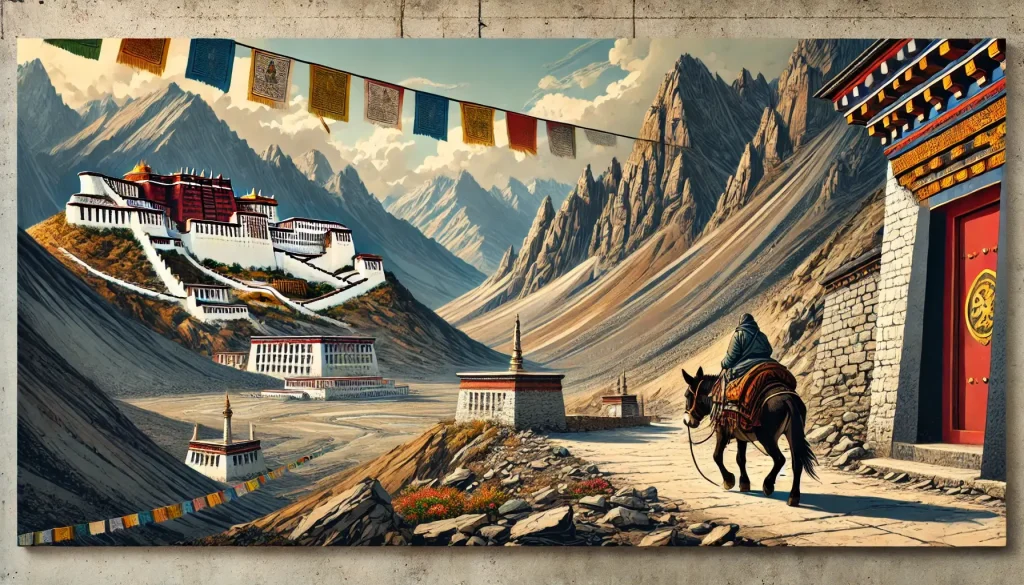
The 450 page book entitled The Ballads of the Tea Horse Trail (by Eva Phileta Wright) sets out in convincing detail the lives of the mule handlers who walked in caravans on the Tea Horse Trail in western China. The Trails and the trade on those Trails had been operation since the Tang Dynasty (618-907 CE) and remained vital lines of communication until done away with by the Chinese rulers of Tibet in the 1950’s and 1960’s.
The non-fictional hero of The Ballads was, as an older adult, was kept away from the Trails due to incarceration as a political prisoner during the Chinese Cultural Revolution. He was only let out of jail after the Chinese, who had taken over Tibet, had done away with the mule caravan industry altogether. The Chinese merely had to wait out the hero’s days of physical mobility by keeping him in jail. Having gotten too old to walk the Trails the way he used to, lacking any ability to contact the other caravan men who had customarily walked together, and, in the end, tied to a non-Tibetan city where he received a near starvation level pension for his services in the army, the hero of The Ballads was effectively prevented from ever taking up his old profession again. He spent the rest of his life in a city south of Tibet where the dominant ethnicity was not his own Tibetan ethnicity. He became another victim of ethnocide.
I think any story of victimization has to be told of the individuals, rather than just the total numbers involved. Otherwise, the bland statement that “a million members of a particular (Tibetan) society were not permitted to live the culture of their ancestors” is too sterile a concept for a reader to react to meaningfully. Any effort to comprehend what makes a different culture click is going to be opaque if the feelings, personal thinking and ethnic honor of people living in that culture aren’t made clear. If you have come to love a particular culture, and then are informed of its demise, you can get an inkling of what that demise must be like for the members of that culture.
A large number of Tibetan people are currently in diaspora, most having escaped to India, and a few having gone farther afield to Europe and the Americas. In any of these cases, life for the refugees is no longer life in the high Himalayas but, usually, life in a hotter environment. The separation of the Tibetan people from their mountain environment is devastating to their culture, which was built up from years of living in very high altitudes.
Efforts are being made to preserve the Vajrayana (religious) teachings that evolved in Tibet. Those teachings themselves evolved out of the need to face and deal with the rigors of living at a very high altitude. When those particular rigors are no longer a part of life, the teachings necessarily focus on the actual rigors of an aspirant’s present life. This development is natural, helpful, and leads to dealing with the new life of the Tibetan people in diaspora, never as settled as the old ways were in the traditional locations. The result is a change in the religious and philosophical backing of the Tibetan culture. This is one of the many reasons why collecting oral histories is so important. The past is so difficult to reclaim or even understand, and is always so closely intertwined with its culture.
It is not helpful to concern ourselves with the magic line between the inevitable change in any society over time, and the sad slow demise of a culture removed from its cultural roots. As an American, we participate in a country of immigrants, since all but native Americans came from a different culture originally, and had to adapt to a new life in the Americas. The native Americans had it worse, as they had to adapt to a largely Caucasian group of invaders who, for the most part, denied the natives the freedom to live their own culture in their own place, forcing the native Americans instead to live on reservation land that the invaders deemed of little interest to themselves.
Possibly it is as a result of being an immigrant society that we so admire youthful vigor and adaptability, and downplay the contributions and memories of the elderly. The adaptability of any culture is important, but so are its roots. Historical fiction is concerned with roots. I hope The Ballads is as meaningful to Tibetans in diaspora as it is to the Americans for whom the book was written, introducing a new and confusingly different, yet amazing and admirable culture from deep in the Himalayas.